

Do you possess the crucial skills needed for successful mortgage loan processing?
Introduction
Within the complex and challenging realm of mortgage lending, mortgage loan processing professionals act as indispensable pillars. Their role is more than just an exercise in administration; it represents the critical crossroads of finance, compliance, and customer service.
But what differentiates a proficient mortgage loan processor from a truly exceptional one? The distinction extends beyond the standard practices and routine processes. It lies within a rich tapestry of specialised skills and competencies that set exceptional processors apart.
In this article, we explore these skills, illuminating their importance and offering insights into how they can be honed for optimal performance in mortgage loan processing. With this understanding, professionals can chart a course towards increased efficiency, effectiveness, and satisfaction in their roles.
Key takeaways
- Mortgage loan processing requires a range of skills such as keen attention to detail, effective communication abilities, organisational and time management, continuous learning and adaptability.
- Utilising digital tools such as project management software, CRM software and loan origination systems can improve efficiency and accuracy.
- Keep up-to-date with industry trends by participating in webinars, workshops, and training sessions.
- Stay adaptable to changes in the mortgage industry by embracing new technologies and processes.
- Brokers' BackOffice offers a team of qualified experts and advanced technology-equipped services to streamline your loan processing journey.
What are the responsibilities carried out by a loan processing professional?
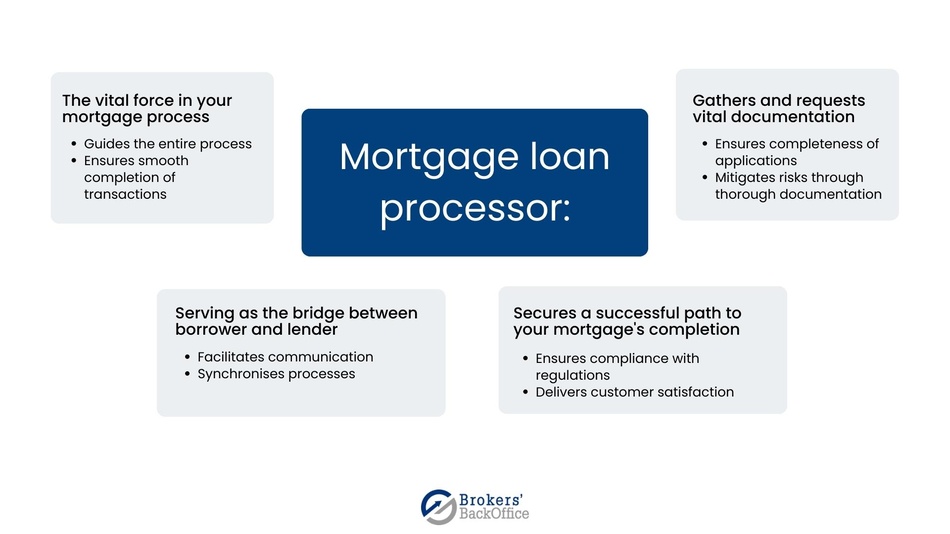
A loan processor serves as the bridge between loan officers, lenders, and clients. This job requires meticulous attention to detail and the ability to handle complex financial and regulatory landscapes.
Loan processing professionals handle loan applications from the initial phase, right after a borrower applies, to the final stage of approval. Their primary task is to verify the accuracy of the application and all accompanying documents, including financial records and credit history. This role requires keen problem-solving skills to address any discrepancies discovered during the verification process.
After ensuring that the loan application and related documents meet the necessary criteria, the loan processor then submits the application to the lender.
The role of the loan processor extends beyond the verification of loan documents. They also coordinate with various parties to gather additional information, liaise with underwriters to resolve any issues and maintain detailed records throughout the loan cycle. Their actions directly impact a lender's risk and a borrower's journey towards securing a loan.
What are the essential skills necessary for a loan processing professional?
-
Detail-oriented nature
In mortgage loan processing, a keen eye for detail is essential. Each document processed is laden with critical information, from a borrower's credit history to their income details. Overlooking a minor detail can lead to misjudging a borrower's loan repayment capacity, potentially resulting in financial risk for the lending institution.
Furthermore, being detail-oriented safeguards the process from regulatory pitfalls. Each loan application must strictly adhere to regulatory guidelines and lender-specific criteria. Missing a single stipulation can delay or derail the approval process, causing customer dissatisfaction and possible legal ramifications.
To cultivate a detail-oriented nature, professionals can leverage various strategies. This includes implementing thorough checklists for loan application reviews, participating in continual training to stay updated on regulatory changes, and practising mindfulness to enhance focus and reduce the likelihood of oversights.
-
Strong numeracy skills
Strong numeracy skills are a cornerstone for professionals in the mortgage loan processing field. These skills facilitate a clear understanding of important financial principles and enable accurate analysis of an applicant's financial health. From evaluating debt-to-income ratios to calculating potential interest costs, numeracy skills play an instrumental role in assessing a borrower's ability to repay the loan.
Furthermore, numeracy skills assist in the interpretation of complex financial data and the construction of effective loan repayment strategies. By accurately analysing an applicant's financial data, loan processors can ensure the provision of suitable loan products that align with the borrower's capacity to repay, contributing to the overall financial well-being of both the client and the lending institution.
To enhance numeracy skills, professionals can take advantage of online financial literacy courses, webinars, and workshops. These can provide invaluable insights into emerging trends and deepen understanding of financial concepts.
-
Excellent communication skills
Exceptional communication skills are indispensable for mortgage loan processors. The role requires clear, concise, and effective communication with various stakeholders, including borrowers, loan officer, lenders, and other associated parties. Each interaction demands clarity to ensure accurate understanding and execution of responsibilities.
Moreover, good communication skills foster a more collaborative work environment, making the intricate loan process smoother and more efficient. Whether it is explaining complex financial jargon to clients, negotiating loan terms with lenders, or discussing application status with a mortgage underwriter, a loan processor's communication skills can significantly impact the outcome of the loan process.
To refine their communication skills, mortgage loan processors can engage in professional development courses emphasising interpersonal skills and actively participate in team-based activities to refine both written and verbal communication. They should also cultivate active listening skills to understand the needs and concerns of clients and team members, facilitating smoother interactions and fostering trust.
-
Critical thinking and problem-solving abilities
These skills allow professionals to make informed decisions by assessing complex situations, identifying potential issues, and developing effective solutions. For instance, if there are discrepancies in loan documents, a processor with strong problem-solving skills can identify the issue, investigate its source, and take appropriate action to rectify it.
Furthermore, critical thinking facilitates the evaluation of a borrower's creditworthiness beyond mere numbers. By assessing various factors such as the borrower's financial situation, employment stability and past financial behaviour, a loan processor can make a holistic judgement about the risk associated with the loan.
To boost these skills, professionals can participate in decision-making workshops or courses focused on critical thinking, which can provide structured learning and practical insights. Moreover, incorporating reflective practice like analysing decisions made and their outcomes can help identify potential improvements and cultivate more effective problem-solving strategies.
-
Organisational and time management skills
These skills are paramount for mortgage loan processors due to the multifaceted nature of their role. Loan processors manage multiple applications simultaneously, each with varying deadlines and requirements. Efficient organisation aids in tracking the progress of each loan file and ensuring timely completion.
Furthermore, good time management can significantly reduce stress and increase productivity. By effectively scheduling tasks and prioritising work, loan processors can ensure a balanced workflow, preventing bottlenecks and last-minute rushes.
To enhance these skills, they can employ various strategies. Using digital tools like project management software can help keep track of multiple tasks, deadlines, and document requirements. Implementing the time-blocking method, wherein specific time slots are allocated to different tasks, can also assist in improving focus and productivity.
-
Continuous learning and adaptability
In today's rapidly evolving mortgage industry, these are crucial skills for mortgage loan processors. These professionals must stay informed about regulatory shifts, changes in lender practices, and advancements in technology to ensure they provide an accurate, efficient, and compliant service.
This can be done by regularly participating in industry-specific webinars, workshops, and training sessions. These platforms provide opportunities to gain insights into the latest industry trends, changes, and best practices. Moreover, subscribing to relevant industry publications, newsletters, and online forums can keep loan processors up-to-date on the latest developments.
On the other hand, adaptability involves being open to new ways of working and adjusting swiftly to changes. This could mean getting comfortable with new technologies, acclimating to changes in team structures, or adapting to new loan processing protocols.
-
Leveraging technology to enhance skills
The digital revolution in the finance sector has introduced an array of tools and software beneficial to mortgage loan processors. Utilising these technologies can enhance essential skills, streamline workflows, and aid in better decision-making.
CRM software aids in improving communication by managing client interactions efficiently. FactFind, for instance, provides a robust platform for obtaining and organising client information, enhancing personalised communication.
Tools like Trello can augment organisational and time management skills by offering visual workflow management and task tracking, improving overall productivity.
Software such as loan origination systems (LOS) and FileInvite automate and simplify steps in the loan process, enabling loan processors to concentrate on critical tasks like borrower evaluation.
Electronic signature services, like DocuSign, streamline the documentation process by allowing secure, legally binding digital signatures, expediting the loan approval process.
By smartly leveraging these technological tools, mortgage loan processors can significantly enhance their skills, leading to improved efficiency, accuracy, and productivity in their work.

How does Brokers' BackOffice empower mortgage loan processing?
At Brokers' BackOffice, a leading outsourced mortgage processing firm, we specialise in providing comprehensive loan processing and back office support services to brokers and mortgage broking firms. We understand the complexity and nuances of the mortgage industry and offer tailored solutions to streamline operations and improve efficiency.
-
Expert team
We boast a team of highly qualified mortgage loan processing professionals who are equipped with all the essential skills necessary for successful loan processing.
-
Staying updated
Our team stays updated with the latest regulations, and lender practices, ensuring we provide a service that's current and compliant.
-
Leveraging technology
We leverage the latest technologies and tools to enhance our services. By using advanced software, we automate and simplify various steps in the loan process, leading to increased efficiency and faster loan approvals.
Final note
Mortgage loan processing professionals play an integral role in the lending landscape, requiring a dynamic set of skills ranging from a keen eye for detail to excellent communication abilities.
By investing in continual learning, staying adaptable to changing regulations, and leveraging technology, they can enhance their performance and contribute significantly to a smooth and efficient lending process.
For firms seeking expert support in these tasks, Brokers' BackOffice stands as a reliable partner, offering highly qualified professionals and a suite of comprehensive services to streamline your loan processing journey.