

In-house vs outsourced paraplanning: Which one is right for your business?
Introduction
The financial advice industry has seen a growing reliance on paraplanners as firms strive to streamline operations and enhance client service. Businesses are now faced with whether to hire in-house paraplanners or outsource support.
Each approach offers distinct advantages—while in-house paraplanners provide seamless integration and collaboration, outsourcing offers flexibility and access to specialised expertise.
Which option is right for your business?
The answer depends on your firm’s specific needs and goals. In this blog, we’ll examine the benefits of in-house and outsourced paraplanning to help you determine the best fit for your practice.
Key takeaways
- Financial firms increasingly depend on paraplanners to improve efficiency and provide better client service.
- The choice between in-house and outsourced paraplanners depends on the firm’s specific needs and goals.
- In-house paraplanners align with the company’s vision, integrating seamlessly into its operations and objectives.
- Outsourced paraplanning services eliminate expenses like staff training, professional development, and coverage for absences.
- A hybrid model combines in-house and outsourced paraplanners to meet varying demands efficiently.
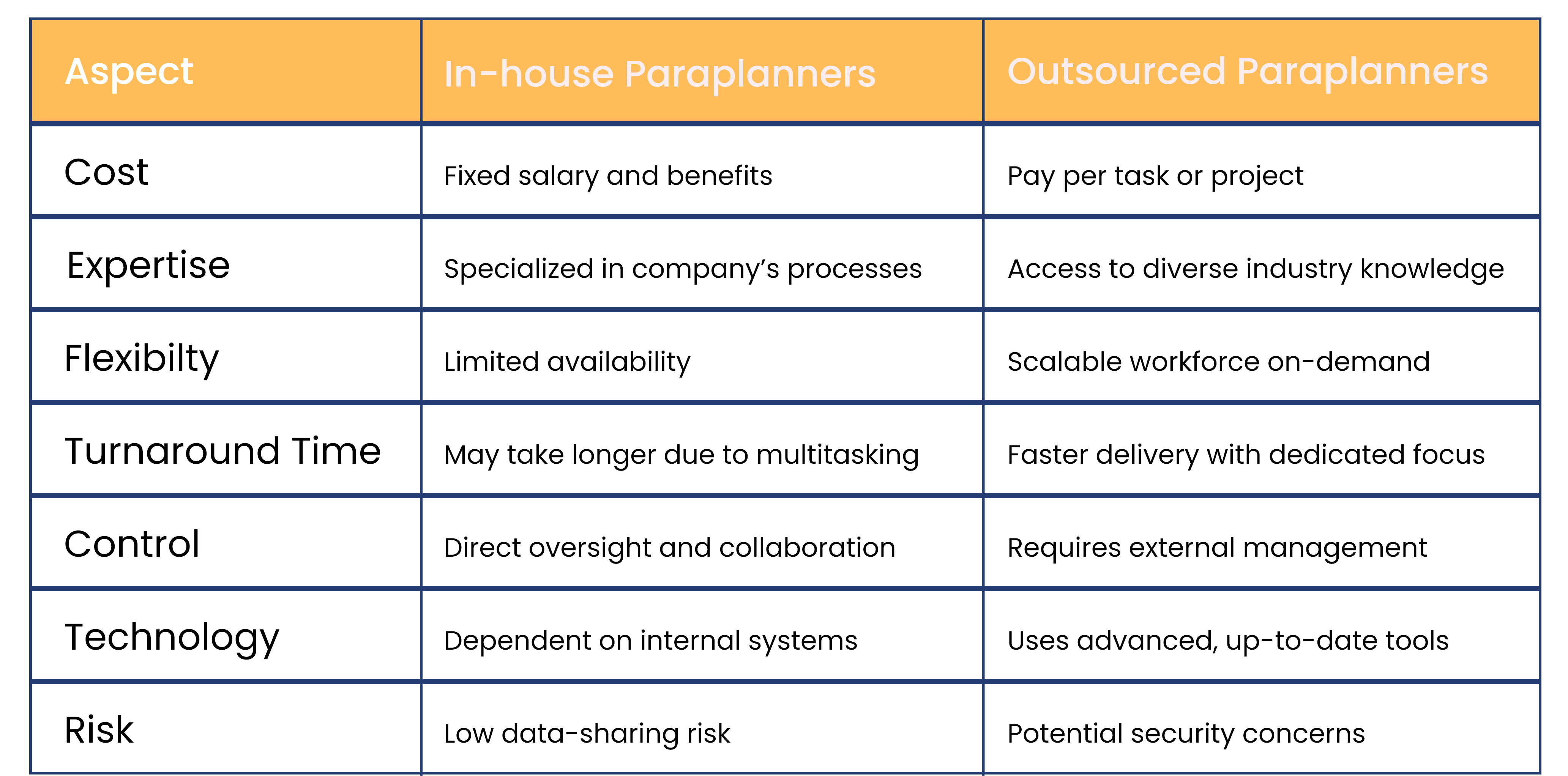
In-house vs outsourced paraplanning: What is it?
In-house paraplanning involves employing a full-time paraplanner who works directly within the company, managing financial planning tasks and aligning processes with the business’s goals and values.
On the other hand, outsourcing paraplanning relies on external professionals or agencies to handle similar tasks remotely.
These paraplanners provide expertise as required, allowing businesses to access support without hiring permanent staff. This method suits companies that prefer adaptable support and a focus on efficiency.
Key benefits of hiring In-house paraplanners
Here are a few benefits of hiring in-house paraplanners:
- Direct alignment with business vision: In-house paraplanners work exclusively for your firm. This allows them to deeply understand your business objectives and effectively tailor their efforts to meet your specific needs.
- Immediate and efficient communication: Being present in the same physical space allows in-house paraplanners to engage directly with advisers, which fosters faster and more transparent communication and enables quick resolution of issues.
- Firm-specific expertise: In-house paraplanners become deeply familiar with your firm’s compliance requirements, investment strategies, and client preferences, which allows them to deliver highly personalised and consistent service over time.
- Enhanced adviser focus: By taking over time-consuming administrative tasks, an in-house paraplanning team allows financial advisers to concentrate on cultivating client relationships and pursuing business growth without distraction.
- Cultural and team fit: In-house paraplanners become a natural part of the firm’s culture and team dynamics, which leads to stronger collaboration and ensures that everyone is working toward the same goals with aligned values.
- Consistency in delivery: With an in-house team, you benefit from long-term continuity as paraplanners are consistently involved in client cases and internal processes, reducing the likelihood of errors and enhancing service reliability.
Key benefits of hiring outsourced paraplanners
Over the last few years, the number of virtual paraplanning providers has grown significantly in Australia.
Financial advisory firms now have the flexibility to choose from various paraplanning services, ranging from freelance paraplanners who offer report writing services, dealing with personal insurance, salary packaging, and debt management schemes to larger firms providing comprehensive solutions like creating financial plans, compliance monitoring, and strategic investment advice, and more.
This diversity offers financial firms the flexibility to match the paraplanning services with their specific needs, allowing them to engage with specialists only when required.
By outsourcing, advisers can access experts with various qualifications, including Diploma holders in Financial Planning, Chartered Financial Planners, and Certified Financial Planner professionals.
Here are a few other benefits of having outsourced paraplanners
Flexibility and cost-effectiveness:
One of the standout advantages of outsourced paraplanning is the cost-efficiency. Outsourcing eliminates the need to bear additional costs related to staff training, continuous professional development (CPD), and covering for absences due to holidays or illness.
Instead, the paraplanning firm handles these responsibilities, offering advisers peace of mind and predictable costs. Services can be availed on a pay-as-you-go basis, allowing your firm to only pay for the service when you use it.
This flexible model ensures you can scale operations according to demand without being tied down by fixed costs or long-term commitments.
Quality control and customisation:
When outsourcing paraplanning services, one common concern is the quality and personalisation of the reports.
Depending on the outsourcing firm, reports may follow a ‘one-size-fits-all’ template or be tailored specifically to meet your firm's values-based advice approach.
While templated reports may offer a faster solution, a customised report reflects your firm's unique approach and values, delivering a more personal client experience.
Regardless of the model, the adviser remains responsible for approving and signing off on the final advice, ensuring it meets their standards and fits the client’s needs.
Streamlining operations:
Financial advisers can dedicate more time to client acquisition and retention by outsourcing paraplanning. The outsourced paraplanner handles research, report writing, and even lifetime cash flow modeling, freeing the adviser to focus on building client relationships.
Additionally, the outsourced model ensures that paraplanning processes continue smoothly even during internal disruption, such as staff turnover or absences.
Virtual Paraplanning that drives your success
Maximise efficiency and expand your capacity with our professional, cost-effective virtual paraplanning services!
Hybrid paraplanning model: Flexible approach
Many firms adopt a hybrid approach, combining in-house and outsourced paraplanning strengths.
This model offers the best of both worlds, providing in-house support for everyday operations while allowing firms to tap into external paraplanning resources when additional help is needed.
Here are a few benefits of adopting hybrid models:
Optimising staffing levels:
The hybrid model allows firms to maintain a core team of in-house paraplanners while utilising outsourced services to manage fluctuating workloads.
For example, if your firm needs the equivalent of 3 paraplanners, hiring 2 in-house and supplementing the rest with external help prevents overstaffing during slower periods while ensuring the team isn’t overwhelmed when demand peaks.
Managing complex projects:
Your firm may encounter projects that don’t fit into the usual day-to-day workflow.
For instance, you might be tasked with developing a comprehensive client risk analysis framework or conducting an in-depth compliance audit with new regulatory changes.
These specialised tasks require focused attention and additional expertise.
By outsourcing paraplanning services for these projects, you ensure your in-house team can continue their regular responsibilities without being diverted.
This approach allows your firm to handle critical, time-sensitive projects efficiently without compromising on the quality of day-to-day operations.
Filling recruitment gaps:
The recruitment process for in-house paraplanners can take time, sometimes months. During this period, gaps in support can strain your team.
Outsourcing allows you to bridge this gap, providing immediate access to paraplanning expertise until a permanent hire is made.
Building collaborative teams:
Some firms worry that using outsourced paraplanners might create friction with in-house staff. However, in practice, this often results in a productive partnership.
External paraplanners frequently bring fresh perspectives and can work closely with your team, sharing knowledge while adapting to your firm's unique processes.
Wrap up
It is important to carefully consider your firm’s unique needs, resources, and goals before settling on a solution for your business.
Conduct thorough research to ensure your chosen option aligns with your objectives and provides peace of mind when selected and implemented correctly; in-house, outsourced, or hybrid models can be effective tools to optimize efficiency and enhance client service.
If outsourcing sounds like the smarter move, let Brokers' BackOffice handle your paraplanning needs. Our outsourced paraplanning service ensures your back office runs smoothly with no interruptions due to staff shortages or training delays.
We provide instant capacity, allowing you to meet demand effortlessly while scaling your business.
By partnering with us, you’ll eliminate the overhead costs of hiring and managing full-time paraplanners, all while gaining access to highly skilled professionals specialised in producing Statements of Advice (SOAs) and other critical documentation.
With our support, you can focus entirely on growing your practice and serving clients without back-office bottlenecks.
Contact us today to know more how we can assist your business.
Table of contents
Introduction Key takeaways In-house vs outsourced paraplanning: What is it? Key benefits of hiring In-house paraplanners Key benefits of hiring outsourced paraplanners Here are a few other benefits of having outsourced paraplanners Hybrid paraplanning model: Flexible approach Wrap up